The problem
B2B payments had not fundamentally changed since ACH in the 1970s, yet five industries alone move more than $18 trillion a year. The process is slow and manual: routing purchase orders and invoices, verifications, 30 to 120 day waits, and chasing money across banks, ERPs, accounting, and logistics platforms by phone and email. It is worse across borders. BBVA wanted to find and validate brand-new businesses it could build in-house, and corporate trade payments was a candidate.
My role
I was one of three people on a small innovation team, two product designers and a content designer, with equal say in defining the product. My focus was discovery and validation: research, concept, and proving the idea, working directly with stakeholders and executives. We followed the Spring Studio innovation method (about 3 days to generate ideas, 6 weeks to prototype and prove the concept, 9 months to launch), with fintech pioneer Eric Bachman as our Entrepreneur-in-Residence guiding us into unfamiliar territory.
The insight that changed everything
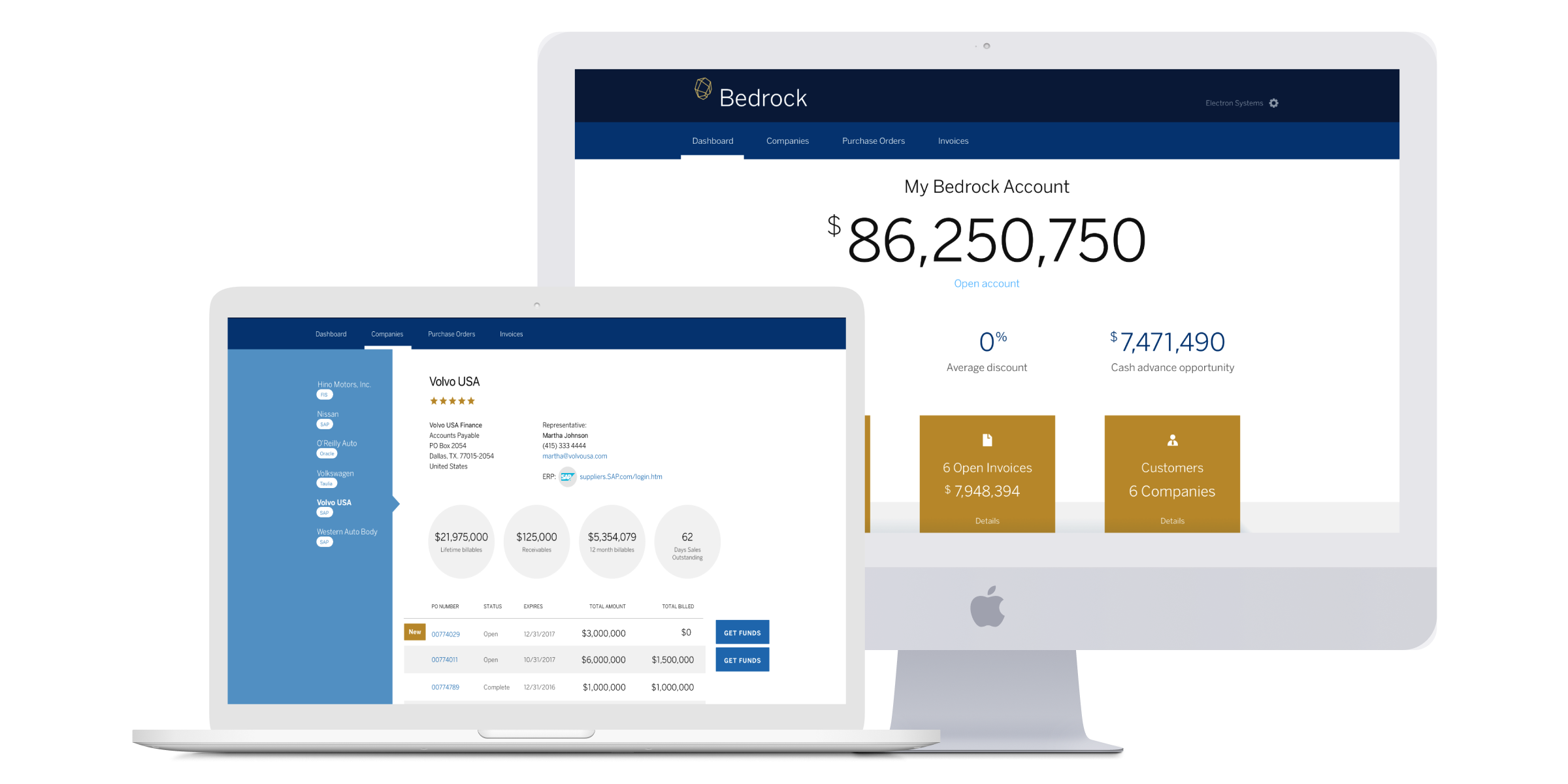
We assumed businesses wanted efficiency and speed. They did not, at least not first. What they wanted most was control over their cashflow. As one executive put it: "Nobody likes surprises." The reality is that when dealing with international payments, some companies break the terms of the contract and there are no international institutions that can hold them accountable, so a smart contract with automated payments can give all parties the trust and confidence they are currently missing.
We pivoted from trying to be another platform, to be an add-on
Instead of building yet another platform, Bedrock became a complementary service that plugs into the systems companies already use (SAP, Oracle, Fiserv, Intuit, and others). It connects banks and ERPs to read a company's financial health and offer cheaper, better-underwritten financing, improving the predictability and accuracy of cashflow. BBVA had a real edge here: Fortune 500 companies already trusted us, and BBVA had backed blockchain early, investing in Coinbase through BBVA Ventures (part of Coinbase's 2015 Series C) and partnering with Civic, Corda, Ethereum, and Hyperledger.
How it worked: payment by milestone
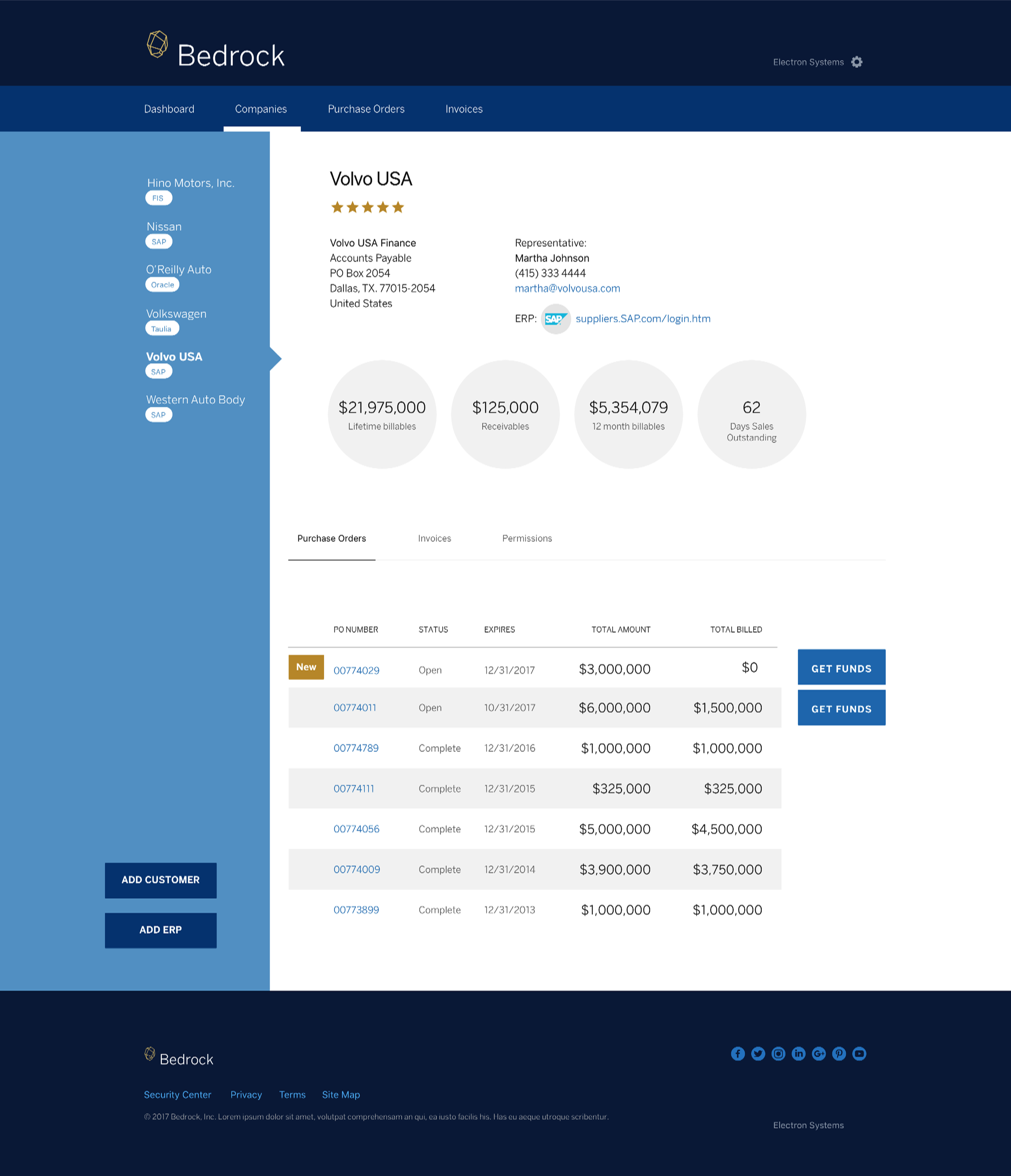
The mechanism that made this work was the smart contract. When two companies transacted, all the terms were defined in a smart contract that lived inside the platform. Payment then released automatically as the goods met the criteria in the contract, in milestones rather than one lump sum at the end.
Take a company shipping hundreds of car engines. An initial payment releases when the engines leave the origin port. Another releases when they arrive at the destination port. The final payment releases when the goods reach the warehouse and pass inspection. No chasing, no manual verification, no week-long exception handling, just predictable, trustable cashflow for both sides, which was exactly what the research said businesses wanted most.

Outcome
The concept was presented to and approved by BBVA's investment committee, securing funding. A separate team inside BBVA then took it into development. The product was ultimately not brought to market; I had moved on to other projects by then, so I cannot speak to the reasons.
What I am proud of is the part I owned: validating a brand-new business through executive research and a sharp, evidence-driven pivot, designing a milestone-based payment model on smart contracts, and proving it well enough to win funding from a global bank.
Learnings
The most valuable insight contradicted our assumption. Listening to what executives actually feared (losing control of their cashflow) was more valuable than the security features of the technology we were excited to implement.